

 V For Vendetta is, unless I'm forgetting or simply unaware of something fairly obvious, Hollywood's first shot at adapting a comic book (or graphic novel, if you must) that features its political content rather than its action set pieces front and center. I'm only just getting into Alan Moore's original book, but it's already fairly clear to me that one of the shakiest wires upon which the film must balance is the one from which the "superhero" element of the story must be served without watering down or rendering hopelessly silly that political content. The hyperstylized world of Moore's novel, illustrated by David Lloyd, allows, as most comic books must, for Herculean suspension of disbelief arrived at, once the graphic novel format is accepted, fairly easily. The movie, which takes place in three-dimensional space, has the same protagonist-- a terrorist operating beneath a Guy Fawkes mask who works to enact vengeance upon and otherwise render to smoking ruins the corrupt British totalitarian state in which he dwells. But in acting out scenarios that might play perfectly well on the page, the filmmakers-- any filmmakers-- risk throwing their intended tone completely off the scale with the slightest misstep.
It's a relief to report that, despite occasional lapses in that tonal balance, V For Vendetta is a strikingly successful achievement, a personal epic that risks alienating its audience by not delivering big action set pieces with metronomic regularity, by liberally dosing them with literary (and, in V's first big on-screen speech, giddily alliterative) allusions, and asking them to identify, in the post 9-11 world, with a "hero" for whom large-scale destruction and small-scale retribution are the only effective tools. It's a relief to experience a movie that doesn't shy away from the most troubling implications of its hero's actions, but instead uses them to not only stir up the audience's emotions but to also get them thinking about why they're reacting the way they are to acts which, in slightly different contexts, could be looked upon not as heroically revolutionary but instead simply destructive, possibly murderous. Of course, the raison d'etre for director James McTeigue and screenwriters Andy and Larry Wachowski in updating Moore's book from its Thatcherian roots (a move that has not pleased the notoriously dyspeptic author) is to encourage the perception of similarities between the repressive, dictatorial regime depicted in the film and the current climate created by waging an increasingly unpopular war for trumped-up or blatantly false reasons and the squandering of civil liberties in the name of national security that have been hallmarks of the post-9/11 Bush administration. V For Vendetta is being released into the world under the auspices of one of those giant corporations-- Time-Warner-- whose interests are of prime importance to those currently in power. But that hasn't dulled the filmmakers' instincts to bite the hand, or attack the sensibilities, of that which feeds them. They've delivered an incendiary entertainment that isn't satisfied with just mounting a vision of a dystopian nightmare-- the avenger V wants his revenge and to kick-start a new order, but he also wants his young charge, the initially politically neutral Evey, to connect the dots back to the roots of that nightmare-- our nightmare-- and that's what the filmmakers want us to do too.
V's mask, that of the 17th-century British seditionist Guy Fawkes, never falls away. (Fawkes, a radical Catholic who planned to blow up Parliament, thereby assassinating both houses and King James I, is burned in effigy in England to this day every November 5, the day Fawkes' "Gunpowder Plot" was foiled.) One of the biggest gambles in V For Vendetta is the handing-over of the film's sympathies to such a visually stylized character, effectively robbing the actor who plays him of an essential tool-- his face-- in the seduction of an audience to those sympathies. Fortunately, for us, Hugo Weaving is the man behind the mask, and he disarms a potential disadvantage by using his mellifluous voice and the subtlety of his body movements to convey what his face cannot. His greatest triumph is in creating a constant desire in the audience to see V's true face, and then inspiring us to hope that it is never revealed, for fear of reducing the richness of the mystery the actor has been able to spin from his circumstances. What Weaving does here is a marvel to behold.
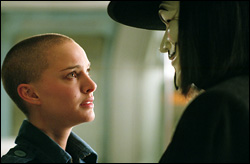 As for his costar, I've never been too solidly in Natalie Portman's camp. Though she was perhaps the best thing about Ted Demme's Beautiful Girls, I thought the exploitation she endured under the watchful eye of Luc Besson (and I don't mean that in a responsible guardian kind of way) in The Professional was borderline criminal. But even through her emergence as a star in vehicles like Where The Heart Is, up through her tragically awful sleepwalk through George Lucas' green-screen universe, and even including her Oscar-nominated breakthrough adult role in Closer, I've never thought she was much of an actress. In V For Vendetta, Portman makes a convincing case for herself as a talented actress. Though barely rising above her familiar ingenue status for the film's first half (in the comic book Evey is introduced turning tricks), Portman has never been better than she is here in an extended sequence after Evey has been captured, shorn of her long locks, imprisoned and subjected to what seems like months of interrogation, torture and isolation. The actress and the film have been criticized for not making the politically reborn Evey more of a woman of action. But it seemed realistic to me that she should, even after her radical readjustment, still need time to find her feet, as it were. And Portman compels us through this dark reimagining of Evey's soul with much empathy and admirable fearlessness. She reflects the audience's ambivalence about supporting V's ultimate plan of destruction; we grapple with the implications for the future of the film's Britain right alongside her, while at the same time ruminating upon the revolutionary origins of our own country.
V For Vendetta is by no means perfect. When Evey's friend, a host of a national TV talk show, played by Stephen Fry, stages a brutal satire of dictatorial figurehead John Hurt (seen throughout the film mostly on video monitors invoking the spirit, if not the letter, of 1984's Big Brother), it seems a crucial misstep that he so arrogantly misjudges the dictatorship's willingness to come directly to his home and shut him down permanently. The incident is used to remind Evey of the abduction and execution of her own parents and lay the groundwork for her own imprisonment, but it's a narratively sloppy way to achieve those ends. Fry's character, who functions largely as a safe-and-sane harbor for the fugitive Evey, for all intents and purposes an above-ground mirror version of V, could have easily served as more than just a ill-thought-out plot device. (I'll be interested to see if the comic book makes the same mistake.) And as rich as the film looks (it was photographed by the late Adrian Biddle, who shot Brazil), it risks being written off as pedestrian and flat-footed when compared to the groundbreaking visualization of Frank Miller's Sin City at the hands of shallow cinematic virtuoso Robert Rodriguez.
 But the way the scenarists, and in particular director McTeigue, fold in the various levels of back-story is inventive and reflective of the chronologically challenging way stories are told in comic books. The fate of Evey's parents, of V's forced participation in a viral conspiracy which results in hundreds of thousands dead, and his own rebirth by fire, and the fate of a gay actress, whose blissful self-awareness and love are destroyed under the government's brutalizing genocidal thumb, all dovetail with the main narrative line in a feat of unexpected resonance, resulting in several sequences that can only be classified as terrifically assured storytelling and bravura filmmaking. An essentially peripheral gay character, seen only in flashback, provides the film with one of its central metaphors ("God is in the rain") as well as its emotional center. V For Vendetta is a political thriller released by a major studio that openly anchors its representation of the repressed underclass, not to mention its sympathies, to the importance of the everyday life and ultimate fate of a lesbian. Now, that seems pretty radical to me. It's a measure of the film's command that it never loses its power to confound our preconceived notions of political expediency and expression, even at those points when its tone wobbles enough to make us aware of the absurdity of a man swooping through the streets of London in a mask, single-handedly doling out bloody justice and somehow escaping the ever-vigilant electronic surveillance that is the lifeblood of the dictatorship he means to destroy. That's the particular province of the comics, that they can sell such absurdities through the urgency of their imagery. Add to that urgency inspired acting, a nimble directorial touch and a passion to engage in a stream of explosive political currency-- a rarity for a film of any stripe-- and you have V For Vendetta.
(Screenwriter Larry Gross goes deeper into the mystery of V, for those who have seen the film already, in an interesting piece at the Movie City News site.)


0 Yorumlar